
Worth County Court Records After a Jail Arrest
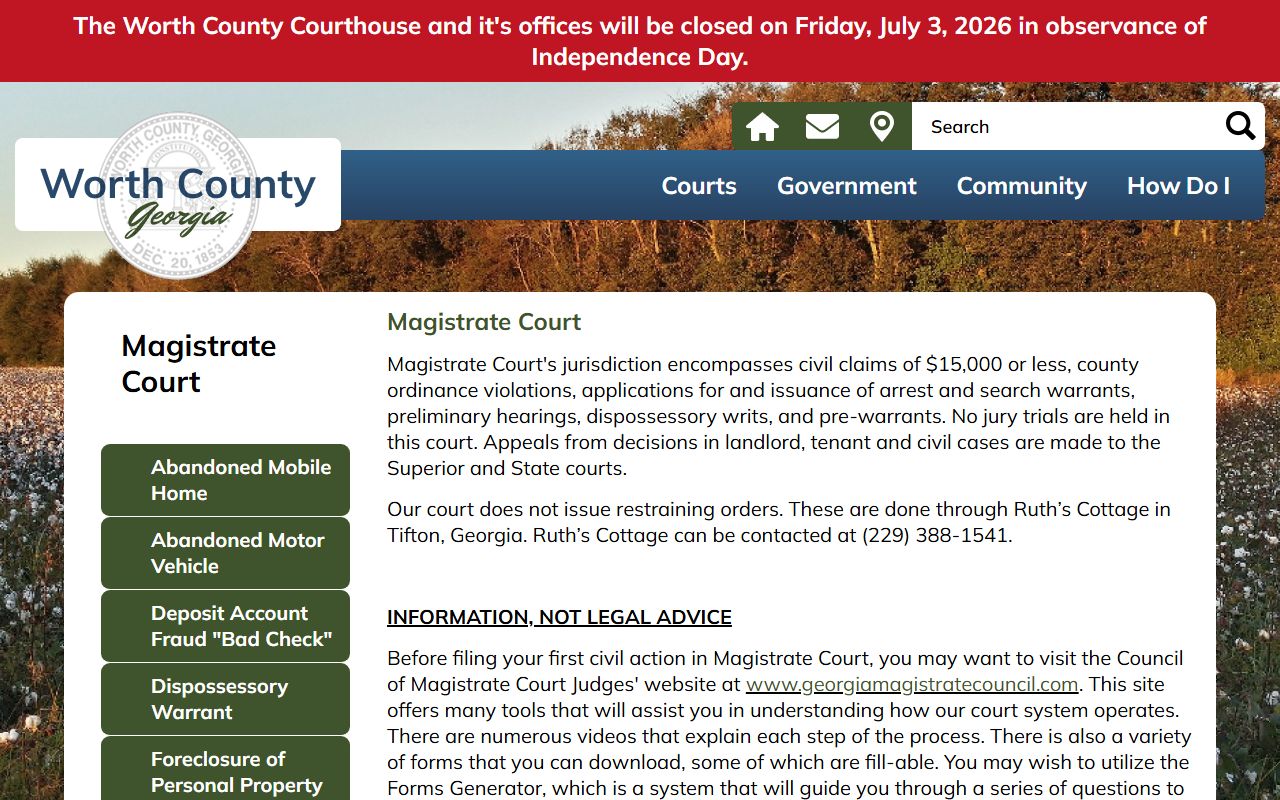
In Worth County, the booking charge in a jail record is an arrest and intake entry. The formal criminal case is handled through the court and prosecutor path. Worth County Magistrate Court handles applications for arrest and search warrants, preliminary hearings, pre-warrants, county ordinance matters, and related first steps. When a warrant leads to custody, the person is taken to jail, fingerprinted, and may post bond. If bond is posted, local research notes that the case often transfers to State Court for misdemeanors or Superior Court for felonies, with a court date sometimes provided while the defendant is still at the Worth County Jail.
The jail side and court side should be read together but not treated as the same record. The jail inmate records route is useful for current custody, arrest date, total bond, and visible charge fields. The court record is the source for filed charges, case status, motions, hearings, and disposition. Booking photos are a separate records issue, and the public roster did not display Worth County photos during inspection, so photo questions belong with jail mugshots and booking photos.
The official Worth County Magistrate Court page identifies the court's warrant, preliminary-hearing, and filing functions.
Find Worth County Court Records
Start by separating custody lookup from court lookup. The sheriff-linked OffenderIndex roster covers Worth County Jail custody and recent booking searches. Court records after an arrest are then checked through Magistrate Court, Georgia Magistrate Records, the Clerk of Courts, and the prosecutor contact route. If the person was arrested on a felony accusation, Worth County's FAQ routes felony case status to the District Attorney at (229) 776-8214. If the matter is a misdemeanor or traffic case, the same local FAQ routes status questions to the Court Solicitor's Office at (229) 387-8005.
- Confirm the arrest and booking details through the jail roster or Jail Operations at (229) 776-3142.
- Identify the likely court path: Magistrate for warrants and first steps, State Court or Solicitor for misdemeanors and traffic, and Superior Court or the District Attorney for felonies.
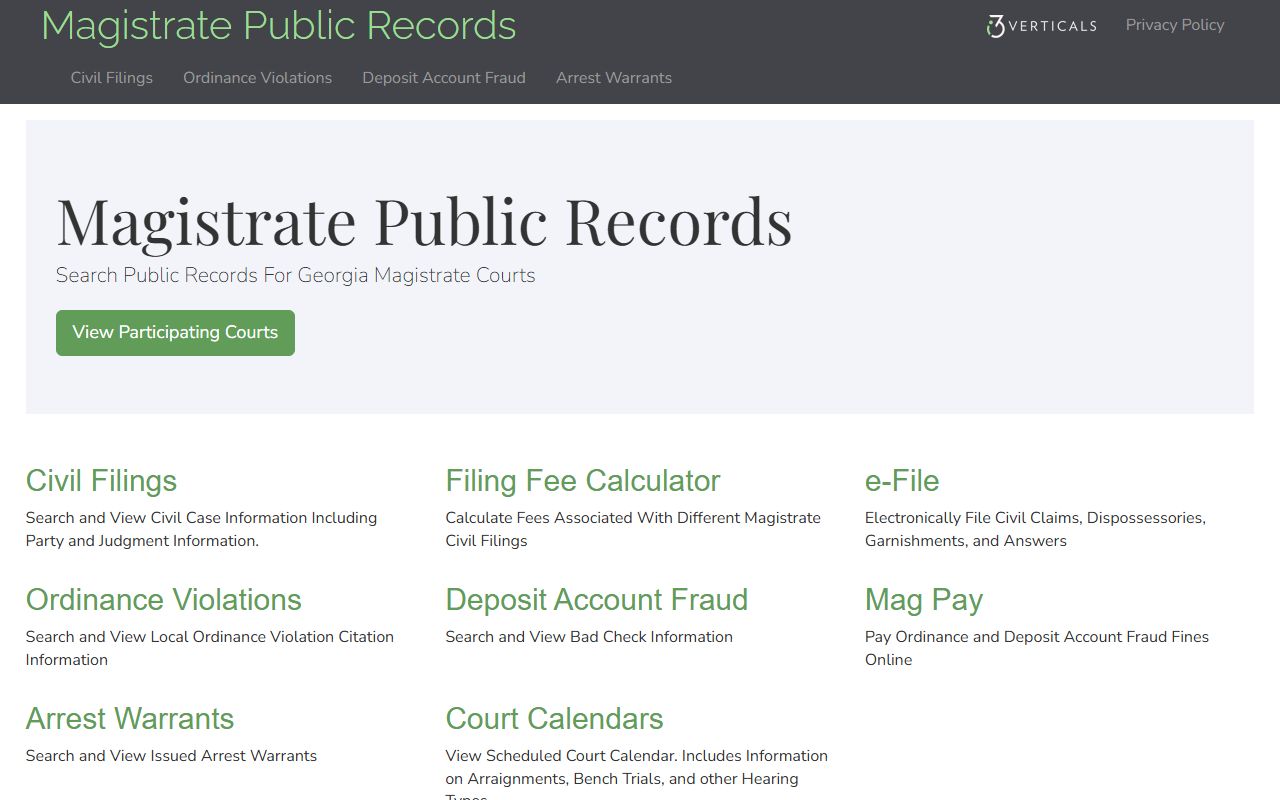
- Use Georgia Magistrate Records for arrest warrants, calendars, ordinance matters, deposit-account fraud, and related lower-court entries.
- Contact the Worth County Clerk of Courts if the online portal does not show the criminal filing, warrant record, certified document, or case detail needed.
- Read each charge separately, because one arrest can produce several counts with different statutes, courts, bond conditions, and statuses.
The Georgia Magistrate Records portal presents public tile links for arrest warrants, court calendars, civil filings, ordinance violations, deposit-account fraud, e-filing, and Mag Pay.
Court Search Access Channels
Worth County research identifies several official channels. Use the table as a routing map, not as a promise that every arrest produces an immediate online case. Some filings appear after prosecutor review, some records require clerk assistance, and certified copies use a separate request process.
| Channel | Type | Requirement | Best Use |
|---|---|---|---|
| Georgia Magistrate Records | Public portal | No account for basic portal access | Arrest warrants, court calendars, ordinance matters, civil filings, deposit-account fraud, Mag Pay, and e-file links. |
| Worth County e-filing | Web filing portal | Account required | Filed Magistrate matters through eFileGeorgia, with an extra fee paid to EZCourtPay. |
| Certified documents | GSCCCA eCertification request | Registration and payment | Certified or uncertified copies by county and document type, with email authentication after payment. |
| Clerk in person or phone | Counter and phone assistance | Case details helpful | Criminal case filings, criminal warrants, traffic fines, and court-record assistance at 201 N Main Street Room 13. |
Clerk, District Attorney, and Solicitor Case Roles
The official Worth County Clerk of Courts page states that Superior Court maintains court records, files criminal cases, maintains criminal warrants, collects Worth County and state traffic tickets and fines, and helps the public obtain court records.
For prosecutor status, the Worth County District Attorney page names Patrick Warren as District Attorney, Melanie Brogden Cooksey as Chief Assistant District Attorney, and Simona Hernandez as victim advocate for Worth County.
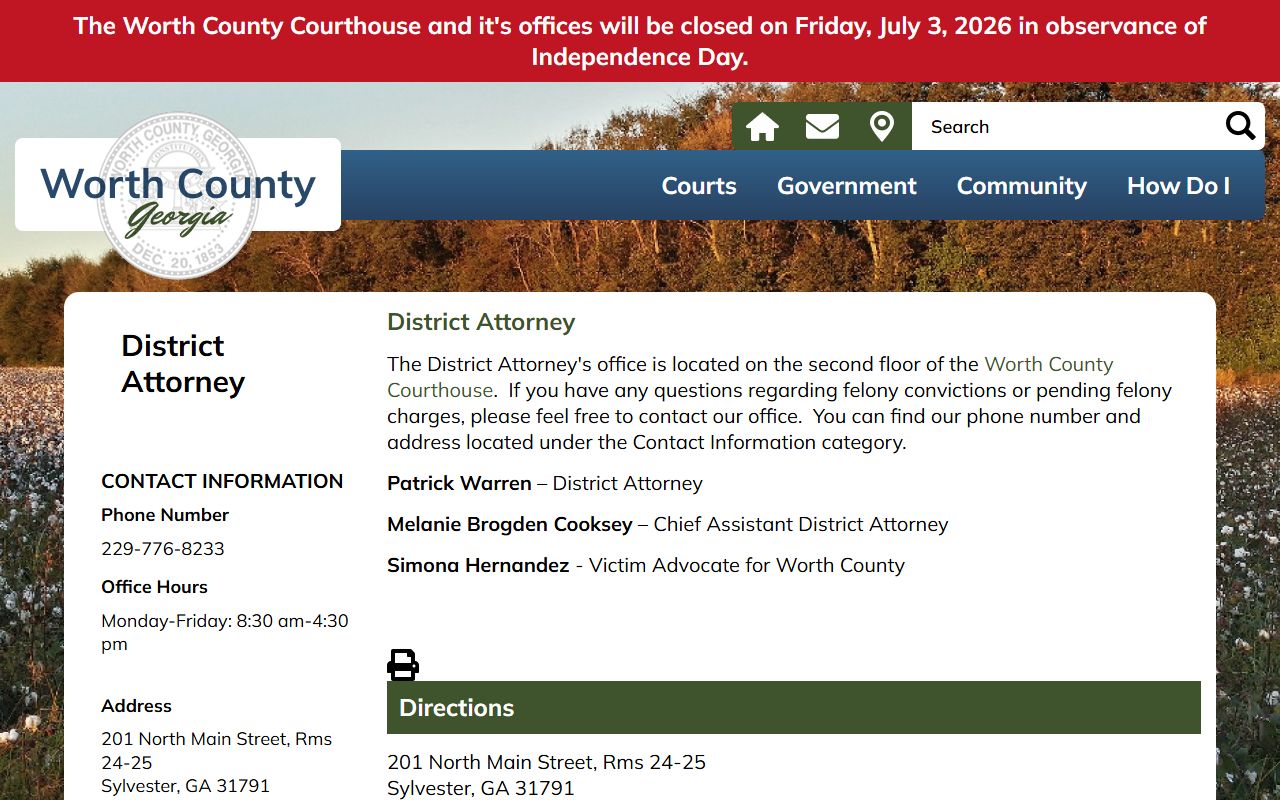
The District Attorney's office is listed on the second floor of the Worth County Courthouse at 201 North Main Street, Rooms 24-25, Sylvester, GA 31791. The Clerk of Courts contact information from the document-request research is 201 N Main Street Room 13, phone 229-776-8205, fax 229-776-8237, office hours 8am to 5pm, and phone hours 9am to 5pm. Those contacts matter because the jail can verify custody and bond facts, but it cannot always explain why a filed charge changed or whether a prosecutor has declined part of a case.
Worth County Charging Documents
The charging document is what moves an arrest accusation into a court case. A jail roster may show the officer's booking description, a statute, a warrant number, or a total bond field. The prosecutor and court record decide what is actually filed. In Worth County, Magistrate Court handles warrant and preliminary-hearing work, the Solicitor route covers many misdemeanor and traffic matters, and the District Attorney route covers felony status.
| Complaint | Information | Indictment | |
|---|---|---|---|
| Usually filed by | Officer, agency, or prosecutor depending on the matter. | Prosecutor. | Grand jury after felony review. |
| Common use | Initial accusation, warrant-related case start, misdemeanors, or ordinance matters. | Filed criminal accusation without grand-jury indictment where Georgia procedure allows it. | Serious felony prosecution in Superior Court. |
| Connection to arrest | May track closely with the booking charge. | May amend, reduce, add, or clarify the booking charge. | May differ from the arrest entry after prosecutor presentation. |
| Where to verify | Magistrate Court, Georgia Magistrate Records, or Clerk records. | Clerk, Solicitor, or District Attorney route. | Clerk of Superior Court and District Attorney route. |
Worth County Charge Status
Charge status can change after arrest because booking is only the intake stage. A prosecutor may file the same allegation, file a lesser offense, add counts, dismiss a count, or choose not to proceed. The public should avoid treating a booking charge as a conviction or final case result. Read the court record by charge, count, statute, court, and disposition.
| Status | What It Means |
|---|---|
| Pending | The charge has not reached final disposition. Hearings, bond conditions, or prosecutor review may still be active. |
| Amended | The prosecutor or court changed the charge wording, statute, count, or offense details from an earlier version. |
| Reduced | A lesser offense replaced the original accusation, often through prosecutor decision or plea negotiation. |
| Dismissed | The court or prosecutor ended that charge. Other counts from the same arrest may still remain. |
| Nolle Prosequi | The prosecutor declined to continue prosecution of that charge. It is not the same as a guilty finding. |
| Conviction | A final guilty plea or finding. It is a disposition, not merely the existence of a booking or filed charge. |
Bond Holds and Release
Worth County's FAQ says a jailed relative will either have a bond hearing immediately after booking or within 72 hours of arrest, depending on the charges, and will have an opportunity to reach someone to arrange bond. The OffenderIndex roster template includes a Total Bond field, but a roster bond amount is not a full court docket. A judge or magistrate sets bond based on the offense and case posture, and a hold can prevent release even when a local bond amount appears.
| Bond Type | How It Works |
|---|---|
| Cash Bond | Money is paid directly as allowed by the court or jail process. Verify accepted methods and hours because Worth County research did not locate published payment details. |
| Surety Bond | A licensed bonding company posts bond for the defendant under court-approved terms. |
| Property Bond | Property may secure release where allowed and approved. Local acceptance must be verified before relying on it. |
| PR or Own Recognizance | The court releases the person on a promise to appear, when ordered. |
| No-Bond Hold | Release is blocked unless the court or holding agency changes the status. |
Ask the jail whether there is a probation or parole hold, DOC pickup, another-county warrant, ICE detainer, or federal hold. Posting Worth County bond may not release a person if another agency has authority to keep custody.
Worth County Arrest Warrants
Worth County Magistrate Court is the primary local source for warrant process. Its page covers applications for and issuance of arrest and search warrants, preliminary hearings, and pre-warrants. The Clerk of Courts maintains criminal warrants, and the Sheriff's contact page lists Kannetha Clem as Office Manager and Warrants Division contact through the sheriff's main phone, (229) 776-8211. No sheriff-hosted public active-warrant list was located in the research.
Georgia Magistrate Records advertises an Arrest Warrants tile, but law-enforcement-only systems such as NCIC or GCIC are not public search databases. A warrant can become visible to the public only after it creates a booking, court entry, or releasable record. Bench warrants from lower courts may need Magistrate, State Court, Solicitor, Clerk, or records-request follow-up. No official Worth County Sheriff or Sylvester Police mobile app with an app-only warrant, roster, or court-record tool was located during research.
Worth County Charge vs Conviction
An arrest charge is an accusation, not a final result. A filed charge is also not a conviction until the case ends with a guilty plea, guilty verdict, or other qualifying disposition. Court records after a jail arrest should be read with that distinction in mind, especially when the same case has several counts or amended charge descriptions.
| Charge | Conviction | |
|---|---|---|
| Stage | Accusation listed at booking or filed in court. | Final guilty plea or finding. |
| Proof level | Booking and filing can be based on probable cause or prosecutor review. | Requires a plea or proof beyond a reasonable doubt. |
| Record effect | May remain pending, be amended, reduced, dismissed, or nolle prossed. | May create sentencing, probation, fines, or custody consequences. |
| Where checked | Jail roster, Magistrate, Clerk, Solicitor, or District Attorney route. | Final court disposition from the Clerk or court record. |
Restricted Worth County Records
Georgia commonly uses the term record restriction. O.C.G.A. 35-3-37 allows certain criminal history records to be restricted for non-criminal-justice purposes when approved under Georgia law. That is different from assuming every dismissed case disappears from all court files. A restriction may limit public dissemination of criminal history, while court access may depend on the record type, order, and agency maintaining the file.
| Sealed or Restricted | Expunged | |
|---|---|---|
| Public visibility | Limited or hidden from ordinary public access for eligible records. | Treated more like removal or destruction where a law actually authorizes that result. |
| Georgia framing | O.C.G.A. 35-3-37 record restriction is the main researched Georgia path. | Do not assume a Georgia arrest is erased unless an official rule or order says so. |
| Agency access | Criminal-justice agencies may retain access for authorized purposes. | Access depends on the specific order and record system. |
| Best next step | Use GBI record-restriction guidance and court or agency orders. | Verify with the court, GBI, or originating agency before relying on removal. |
Background Check Considerations
Georgia open-record and court-record access is not the same as a regulated employment, tenant, credit, or insurance background check. A casual lookup can miss amendments, restrictions, sealed records, delayed filings, and prosecutor decisions. For official use, rely on the originating court, the Clerk, the prosecuting office, and any legally required consumer-reporting process.
Important: Worth County Inmate Population is not a consumer reporting agency under the Fair Credit Reporting Act, and its information may not be used for FCRA-covered decisions.
Worth County Access Limits
Georgia's Open Records Act, O.C.G.A. 50-18-70 et seq., broadly covers records prepared or maintained by public agencies unless an exemption applies. O.C.G.A. 50-18-71 addresses timing and fees, including the general three-business-day response framework described in the Georgia Attorney General FAQ and reflected in Worth County's open-records form. Even so, juvenile matters, restricted criminal history, sealed files, active investigations, victim-sensitive material, and records covered by a court order may be withheld or redacted.
For Worth County jail records that are not online, the sheriff's open-records route uses openrecords@worthcosheriff.com. For court records, the better starting point is the Clerk, Magistrate Court, Georgia Magistrate Records, or the prosecutor contact that matches the charge level. That division matters because the sheriff maintains custody and booking records, while courts and prosecutors maintain the criminal case record after arrest.